

IdeaPOP! 2026 Champions | KTMC's Team Responds to SEN Learning Needs Through Melody, Opening New Doors for Students with Learning Difficulties
Sometimes, the best way to memorise something has always been hidden in your everyday habit of listening to music.
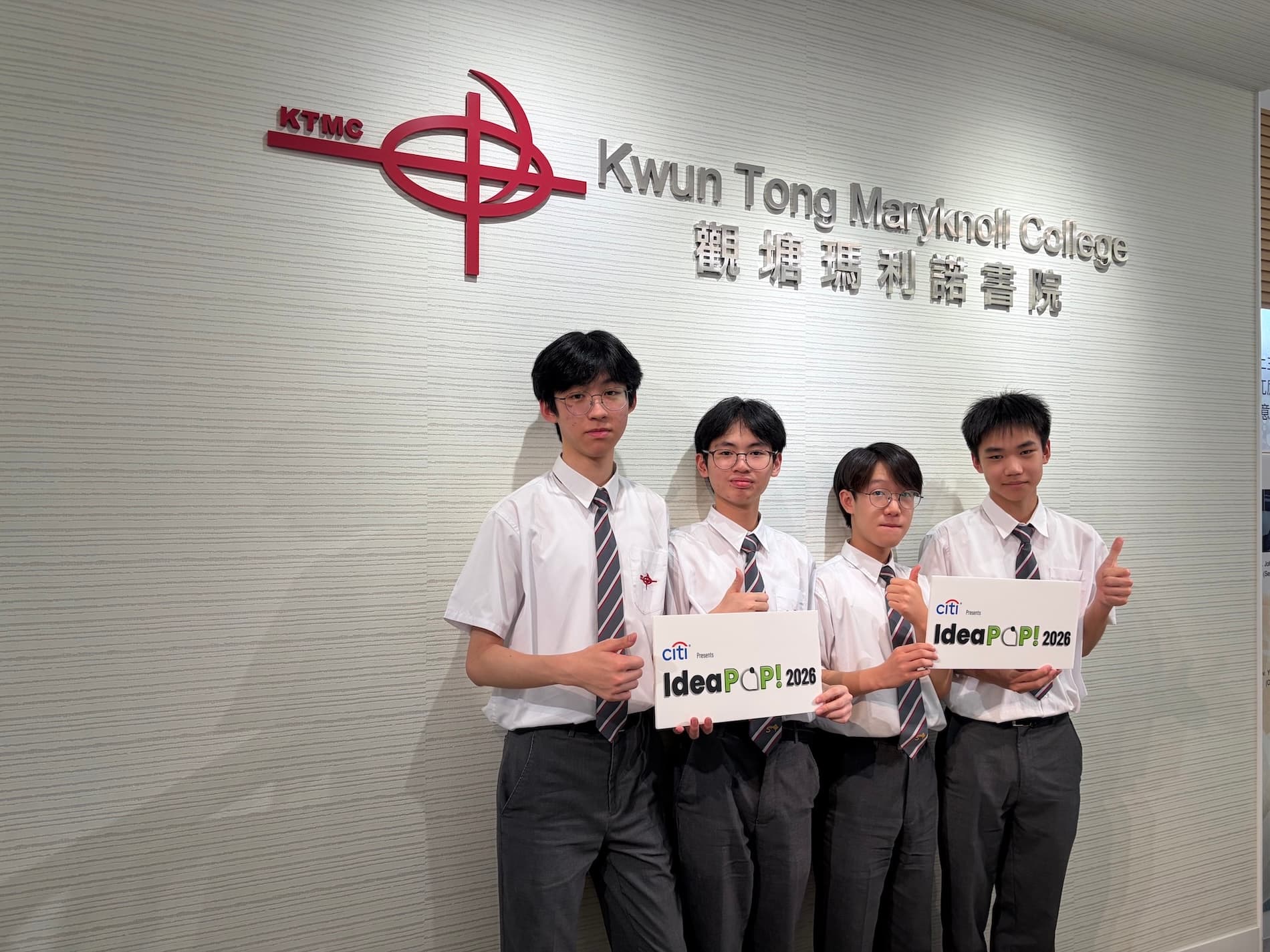
The champions of IdeaPOP! 2026 Secondary School Startup Pitching Competition are four students from Kwun Tong Maryknoll College (KTMC). Using AI to transform academic content into songs, they competed with their product "Rhythmarise". The entire idea began with a Classical Chinese Ci Poetry, 水調歌頭 (Prelude to Water Melody), that a Secondary 3 student struggled to memorise, and a simple discovery: following a melody can actually help something stick far better in the mind.
Where the Product Began
The product idea from the four KTMC students grew out of a very real learning frustration.
Team member Lawrence mentioned that when he was in Secondary 3, he had to memorise a Classical Chinese Ci Poetry "水調歌頭" but simply could not get it to stay in his head. He then tried listening to Hong Kong famous singer Faye Wong's song "但願人長久", and as he listened and sang along, he gradually remembered the words. Following the lyrics with a melody turned out to be so much easier than rote memorisation. This method is not unfamiliar to most people. Just like the alphabet song, the multiplication table song, or mnemonic rhymes for trigonometric functions, many of us used these as children. Yet no one had ever systematically turned this into a learning tool that could be applied across more students and more subjects. That thought became the starting point for their entry into IdeaPOP! 2026.
IdeaPOP! asks participants to respond to real social issues, and this encouraged the four KTMC students to look at the bigger picture. After extensive research, they found that difficulty with memorisation was a far more pressing issue for some students than they had imagined. Students with Special Educational Needs (SEN), ADHD, or dyslexia already find it much harder than their peers to find a learning pace that suits them in mainstream classrooms. Auditory learning is not widely practised in Hong Kong, yet for these students, it may be exactly the option they have always been missing.
"Everyone has different learning needs. What we want to do is give students who need it one more option." said team member Jacky.
The Trial and Error Work Behind AI-Generated Songs
The core of Rhythmarise is using AI to transform academic content into songs, helping students memorise material and reinforce their understanding. It sounds straightforward, but the journey was filled with challenges. Team member Jayden admitted that they tried R&B, they tried Jazz, and at times the AI's pronunciation was unclear, while at other times the melody was too fast to follow. They had no choice but to adjust again and again, slowly finding the balance between lyrics and tune.
They paid particular attention to the fact that students with different SEN profiles also have different needs when using the product. If the generated music was too fast in tempo, students with dyslexia could not keep up; if the pronunciation was unclear, students with ADHD were more easily distracted. These are the kinds of details that might not be prioritised in typical product development, but for the team, they were among the key areas of repeated testing.
Beyond the technology, pricing was another significant challenge. They conducted surveys and found that students were on average willing to pay forty to fifty Hong Kong Dollars per month to use the tool. However, the team wanted it to be accessible to more people, including families of students who needed extra learning support but might not have room in their budget for it. They lowered the price, bringing it below cost, going back and forth several times before finally landing on a price that was "not running at a loss, yet reachable by as many people as possible."
"Because we wanted to help people from different backgrounds, pricing turned out to be even harder than the technical research."
Behind all these repeated adjustments was their genuine hope that the product would actually be used. Not just to win a competition, but to make this tool truly helpful to more students in need.
The Most Unforgettable Moment on Stage
If there were one moment from the entire competition that left the deepest impression on everyone, it was probably the judges' Q&A.
A judge asked: "Have you actually used this method to study?"
They chose the most convincing way to answer. The four of them exchanged a glance, and then began to sing the opening lines of the poetry: "明月幾時有,把酒問青天。不知天上宮闕,今夕是何年。"
Four voices rang out together in the competition venue. The air in that moment suddenly felt different.
When recalling that instant, there was still a trace of shyness on their faces, quickly followed by laughter.
Team member Lawrence shared what was going through his mind at that moment: "Right then, I just thought, we rarely get a chance to stand on stage like this. We might as well go all in."
Not everyone could do something like that. Singing in front of the judges and the audience required more than just courage. They knew clearly why they were standing on that stage, and they understood that moving the people in front of them mattered far more than protecting their own face.
The Moment the Champions Were Announced
When the champions were announced, each of the four had their own reaction. Some were overjoyed, some let out a breath of relief, and one had five words flash through their mind: I finally did it.
Outsiders only see the result on stage. They do not see the late nights of back-and-forth discussion in the group chat, or the moments of starting over from scratch. Those five words were said to oneself.
Though their reactions differed, all of them shared one thing in common. Every single one of them had worried at some point about whether they could succeed. They worried that all those endless meetings, the presentations that never felt fully ready, and the plans revised again and again would amount to nothing in the end. That worry existed precisely because they had genuinely put their hearts into it and were afraid of it going to waste.
Entrepreneurship Is About Responding to Real User Needs
Before joining IdeaPOP! 2026, they assumed that entrepreneurship required a perfect and novel idea. It was only after several mentor meetings from IdeaPOP that they realised it was not quite like that.
"Entrepreneurship is about meeting the needs of the public and solving real pain points. That is what real entrepreneurship looks like." said team member Jacky.
And this understanding was validated again and again throughout the process. Every pricing revision, every survey filled out and revised, every consideration given to the learning needs of SEN students was a response to real user needs. It was not done to fill up slides in a startup pitch deck, but because they had genuinely connected with those students and understood just how significant the gap in their learning experience truly was.
Division of responsibilities was another lesson they learned.
Before the competition, team member Alvin was used to handling everything himself: conceptualising the design, preparing slides, drafting the script. He thought that was what it meant to give your best. It was only later that he came to understand: "If you do everything yourself, you are not recognising your own strengths or figuring out where you should really be positioned." Learning to each play their own role was what allowed the team to go further together.
What IdeaPOP! 2026 gave them was more than a trophy. It gave them the way they speak, the courage to stand on stage, and the chance to give everything they had to one meaningful endeavour.
A Message to Future Participants
At the end of the interview, they offered three pieces of advice to students considering taking part. First, believe that you can win. If you do not believe in yourself, no one else will. Second, do not be too nervous. On the day of the competition, one team member was so nervous they had a stomachache, and they were fortunate to have brought stomach medicine along. Third, do not fear the awkward. You are already standing on that stage, and your goal is to win. Even if what you need to say feels embarrassing, say it anyway, because your job is to move the people sitting in front of you.
The Impact IdeaPOP! 2026 Hopes to Create
The story of the KTMC students is a story about trying wholeheartedly. From a poem that was impossible to memorise, to a product hoping to help SEN students find their own learning rhythm, and then to that powerful proof delivered through song.
They never pretended to have everything under control. In the face of uncertainty, they simply chose to give everything they had.
That is exactly the spirit that IdeaPOP! has always hoped every participant will carry with them. A perfect idea is never the starting point. The real starting point is the willingness to try, the willingness to adjust, and the willingness to face whatever challenges arise on that stage.